Citrix vs Windows 365: a decision framework for IT leaders
Compare Citrix and Windows 365 across architecture, cost, security, and management overhead to find the right fit for your team.
G2 Names Nerdio a Leader Across Fall 2026 Reports for Desktop as a Service Read the blog
Compare Citrix and Windows 365 across architecture, cost, security, and management overhead to find the right fit for your team.
Carisa Stringer | September 19, 2025
Table of Contents
The Citrix-versus-Windows 365 decision centers on how much desktop infrastructure your team wants to run, manage, and own. One platform gives you a toolkit and expects you to design and operate the environment yourself.
The other hands you a finished Cloud PC and manages most of the backend for you. The dividing line that matters is operational responsibility, and that line runs through both options no matter which you pick.
This guide is for IT directors and end user computing leads building the Citrix-versus-Windows 365 recommendation. It maps each platform to operational responsibility, cost, security, and workload fit.
Windows Cloud is Microsoft's umbrella term for Azure Virtual Desktop and Windows 365 together, and it's the broader context these choices sit inside. Cost and feature differences between Citrix and Windows 365 are real, but what actually determines whether either choice succeeds is management overhead at enterprise scale, even for the platform that looks simpler.
Citrix Desktop as a Service (DaaS) is a virtualization toolkit. Windows 365 is a finished, Microsoft-managed Cloud PC product. The toolkit creates more design and operating decisions for your team. The product gives you predictability and trades away some customization.
The biggest differences show up across architecture, protocol, desktop model, control, cost, and workload fit.
|
Citrix DaaS |
Windows 365 |
|
|
Core concept |
A toolkit to build custom virtual desktop environments |
A finished, Microsoft-managed Cloud PC product |
|
Architecture |
Hybrid and multi-cloud design. A central control plane manages resources your team hosts on Azure, AWS, GCP, or on-premises |
Microsoft cloud native. Hosted and managed by Microsoft within Azure, integrated with Microsoft Intune |
|
Performance protocol |
Citrix HDX. A separate protocol layer your team must configure, test, and support for each user group |
Microsoft RDP with RDP Shortpath. Built into the Windows experience and integrated with Microsoft services |
|
Desktop model |
Persistent and non-persistent design choices, including pooled multi-session desktops |
Persistent for standard Windows 365 Enterprise Cloud PCs. Every user gets a dedicated, personalized Cloud PC |
|
Security and control |
Separate policy controls across session elements |
Integrated with the Microsoft security stack (Entra ID, Intune, Defender) |
|
Cost model |
Consumption-based. Citrix licenses plus underlying cloud infrastructure |
Fixed monthly fee. Predictable per-user, per-month license covering compute and storage |
|
Common evaluation scenarios |
Existing complex hybrid and multi-cloud estates, graphics or peripheral requirements that need testing, task-worker scenarios |
Organizations standardized on Microsoft 365 that want predictable budgeting and deployment through Microsoft management surfaces for knowledge workers |
Citrix DaaS is Citrix's cloud-hosted offering, distinct from the on-premises Citrix Virtual Apps and Desktops product. It requires your team to build and maintain a desktop and application environment across on-premises data centers and public cloud infrastructure.
Microsoft has another option too: Azure Virtual Desktop, a customizable, cloud-native virtualization service. Even though both run inside Azure, both deliver Windows 11 Enterprise, and both authenticate through Microsoft Entra ID, Windows 365 and Azure Virtual Desktop remain distinct products.
Specifically, Windows 365 is the fixed-price, Microsoft-managed Cloud PC, while Azure Virtual Desktop is consumption-based and customer-managed. Together, they make up the Windows Cloud portfolio, and as a result, many enterprises run both, choosing the right one per workload. For a closer look at cost, see Nerdio's guide on AVD vs. W365 cost.
Architecture decides where you can run desktops, how much expertise your team needs, and what it costs to operate. Here's how Citrix and Windows 365 differ.
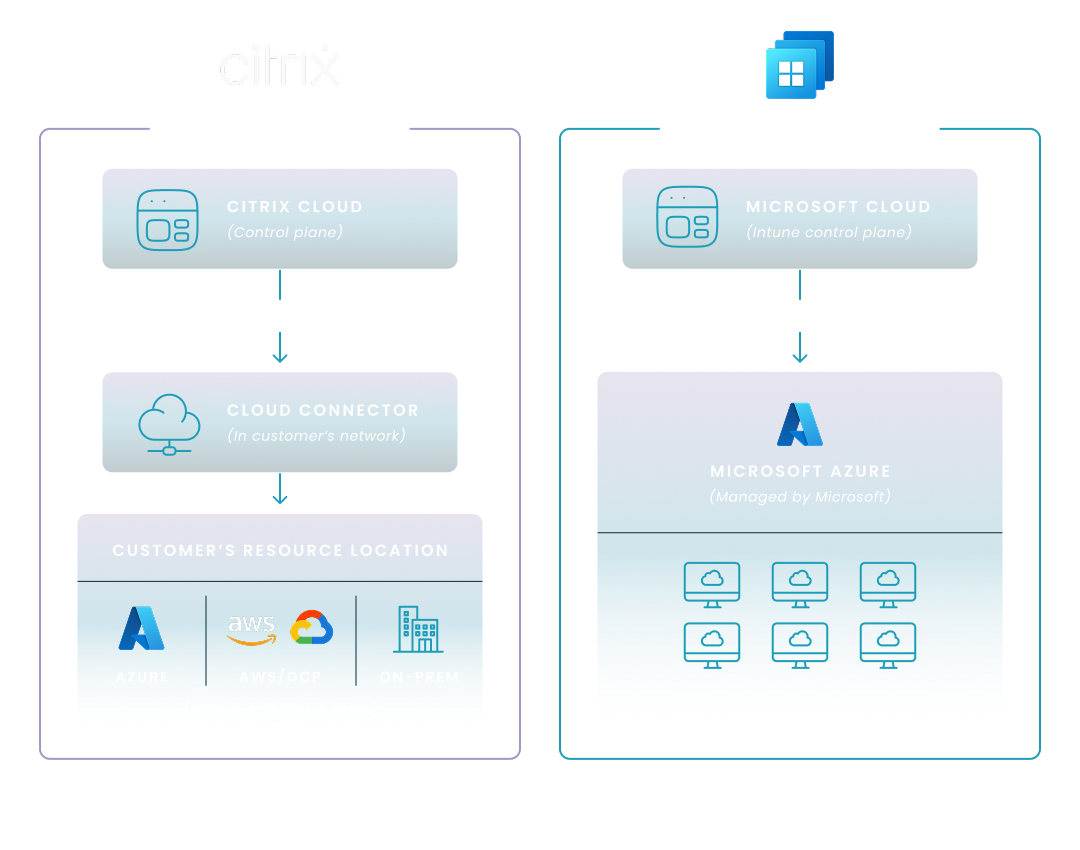
The Citrix architecture splits the management plane from where your desktops actually run, which is what makes its deployment model flexible.
The control plane lives in Citrix Cloud, which orchestrates user connections, licensing, and administration. From there, your desktop workloads can sit across Azure, AWS, GCP, or your own data centers, running on hypervisors like VMware ESX/vSphere or Microsoft Hyper-V.
To connect the two, lightweight Cloud Connectors installed in each resource location create a secure channel back to the control plane. For external access, the Citrix Gateway Service routes users in through the Citrix client. Underneath all of this, the HDX protocol handles session delivery and tuning.
The flexibility comes at a price: every resource location you add is another environment your team has to design, secure, and maintain.
Windows 365 is hosted and managed entirely by Microsoft, with management running through the Microsoft Intune admin center, the same surface IT teams already use for physical endpoints.
Cloud PCs can run on a Microsoft-hosted network or connect directly to your own Azure virtual network for access to on-premises resources. Sessions are delivered over Microsoft RDP.
The trade-off works like this: you give up the freedom to host desktops wherever you want, and in exchange Microsoft runs the infrastructure layer. For organizations already standardized on Microsoft, that's usually the point.
The management work shifts from infrastructure to endpoints. A management platform like Nerdio Manager for Enterprise sits across both surfaces, a topic covered in more detail later in this guide.
This guide explains why AVD with Nerdio is the best answer to the Citrix challenge.
Performance is what the end user feels, and it usually shows up first as a helpdesk ticket, not a line on a cost report. A choppy connection or a laggy app doesn't cost anything on paper, but it costs IT credibility with the rest of the business. Two things drive it: the protocol that delivers the session, and the desktop model behind it.
Citrix uses its own protocol, HDX, to deliver sessions across a wide range of networks and devices. HDX often matters most for:
Each of these isn't a one-time configuration. Instead, it's ongoing work: testing compatibility whenever devices or apps change, writing policies for each scenario, and troubleshooting issues unique to that network or peripheral setup.
Windows 365 delivers sessions using Microsoft's RDP protocol, built natively into the operating system. RDP Shortpath creates a more direct, lower-latency connection than standard RDP.
It runs over UDP for speed, with a protocol called URCP managing network conditions, and falls back to TCP if the UDP connection fails. On public networks, it tries a direct connection first and falls back to a relayed connection through a Microsoft server if a direct path isn't available, per Microsoft's RDP Shortpath documentation.
Windows 365 supports this public-network version of RDP Shortpath to improve connectivity in poor network conditions.
Yes, but differently: Windows 365 is persistent by default, so every user gets a dedicated Cloud PC where data, settings, and installed apps survive between sessions, exactly like a physical PC. It's a personalized, consistent experience. Citrix, on the other hand, lets you choose.
Citrix requires a design choice between persistent desktops and non-persistent desktops, which are built from a golden image and reset to a clean state every time a user logs off. Non-persistent is used for call centers, training labs, and task-based workers.
Azure Virtual Desktop adds a third option: multi-session pooled hosts, where multiple users share one host but each gets an individual session. If you need a non-persistent or pooled model and want to stay inside the Microsoft ecosystem, Azure Virtual Desktop is the better fit.
Windows 365 has its own shared model too: Flex Shared (formerly Windows 365 Frontline Shared), built for shift workers who connect to a different machine each time. In practice, many large organizations run both persistent and non-persistent desktops, matching the platform to the workload.
Both Citrix and Windows 365 include strong security controls, but they differ in granularity and in which toolset enforces them. This section matters most to the compliance and risk stakeholders in your buying committee.
Citrix gives you a separate policy engine that your team has to configure and maintain, one that covers everything from clipboard access and printer redirection to whether users can save files to network drives from their local device.
Additional features include session watermarking, app protection policies that block screen scraping and keylogging, and security analytics for anomalous behavior. Architecturally, corporate data and apps stay isolated in the data center or cloud instead of being stored directly on unmanaged endpoints.
Windows 365 uses the integrated Microsoft security stack, a natural fit for organizations already standardized on Microsoft: it integrates natively with Microsoft Entra ID for identity and Conditional Access.
IT teams manage Cloud PCs through Microsoft Intune, so the same security baselines, compliance policies, and endpoint protection configurations apply to both physical and virtual PCs. IT teams can also onboard Cloud PCs to Microsoft Defender for Endpoint for preventative protection, post-breach detection, and automated investigation and response.
Citrix means learning and maintaining a separate control surface. Windows 365 folds desktop security into the Microsoft management tools your team likely already uses.
Join us for a webinar to discover how to take Windows to the cloud. Get insights from industry leaders on navigating the modern workspace and driving secure, cloud-powered operations.
Windows 365 offers pricing predictability. Citrix creates more variables you have to model, tune, and monitor. A complete cost comparison has to account for three layers: compute infrastructure, Microsoft OS and access licensing, and any third-party software like Citrix or a management platform.
|
Citrix DaaS |
Windows 365 |
|
|
Pricing model |
Consumption-based. Citrix licenses plus underlying cloud infrastructure |
Fixed, predictable per-user, per-month fee |
|
Includes |
Citrix software licenses |
Compute, storage, and data transfer within limits |
|
Additional costs |
All Azure, AWS, or GCP infrastructure (compute, storage, networking) |
On-premises network connectivity, enhanced security licenses |
|
Best for |
Environments prepared to tune pooled multi-session, non-persistent desktops, and multi-cloud hosting |
Budget predictability and simplified purchasing |
Microsoft sells Windows 365 Enterprise as a fixed-price Windows 365 subscription per user, per month. As of this writing, per Microsoft's published pricing, the three standard tiers run $31.00, $41.00, and $66.00 per user per month, scaling with vCPU, RAM, and storage. Organizations that configure a custom Cloud PC beyond these three tiers pay more.
The price covers the Azure compute, storage, and some data transfer for the Cloud PC. According to Microsoft's licensing requirements, Microsoft 365 Business Premium, F3, E3, and E5 include the prerequisites you need: Windows Enterprise, Microsoft Intune, and Microsoft Entra ID P1.
Predictability is the feature here. Costs don't fluctuate with user activity, so you can set a budget once and skip the surprise bills.
There's also Windows 365 Flex for shift and shared-use scenarios. According to Microsoft's licensing terms, Flex Dedicated supports a shared license where users never overlap in time, and Flex Shared supports a shift-worker model where the user connects to a different machine every time.
For follow-the-sun teams or healthcare shift workers who never overlap, Flex Dedicated can cover up to three users on a single license.
Citrix pricing is consumption-based and has two parts. You pay for Citrix DaaS licenses, a subscription per user or per device. Then you pay for the infrastructure your desktops consume: the VMs, storage, and data egress on Azure, AWS, GCP, or your own hardware.
This model has more variables to tune, especially if you pair it with Azure Virtual Desktop auto-scaling, which powers down and deallocates VMs when they're not in use.
Tuning that auto-scaling well takes real effort, and it's exactly the kind of ongoing cost-control work a management platform like Nerdio Manager automates for you instead of you tuning it by hand.
For Windows 365 environments on the same platform, Nerdio Manager also handles Unified Application Management, Nerdio Advisor right-sizing and Flex recommendations, and Intune policy backup and restore.
The right choice depends on your workloads, your existing infrastructure, and how your users work. Match your use case to each platform's operating model, and the recommendation gets easier to defend.
Reach for Windows 365 when your priorities lean toward standardization and predictability over raw flexibility, such as:
These Cloud PCs typically run Windows 11 Enterprise, with the familiar interface plus the security and management features built in for corporate environments.
Citrix tends to win the evaluation when your environment already carries complexity Windows 365 wasn't built to absorb, such as:
Teams are also increasingly re-evaluating Citrix because of cost pressure, licensing changes, and modernization initiatives. See Nerdio's Citrix TCO analysis for the full picture beyond the license fee.
The two can also coexist: Citrix HDX Plus for Windows 365 lets you apply Citrix's HDX protocol and session controls on top of Windows 365 Cloud PCs, for teams that want the predictable Cloud PC model but still need HDX for specific user groups. This isn't always a clean either-or decision.
Join us for a webinar to discover how to take Windows to the cloud. Get insights from industry leaders on navigating the modern workspace and driving secure, cloud-powered operations.
Whether you pick Citrix, Windows 365, or Azure Virtual Desktop, enterprise deployments bring image management, cost control, provisioning, policy enforcement, and monitoring. The product you choose changes the work, not the existence of the work.
Windows 365 shifts operational work into Microsoft Intune management, including endpoint policies, application deployment, compliance baselines, and license right-sizing.
Native Intune app delivery can take up to three hours, and right-sizing licenses requires usage data that many teams don't already track. Different work than running Citrix infrastructure, but real work.
Nerdio Manager is a cloud desktop management platform that deploys into your own Azure environment and provides a single console for Windows 365, Microsoft Intune, and Azure Virtual Desktop. It extends Microsoft's native capabilities and keeps those capabilities in place.
For IT teams, the practical value is managing related Windows Cloud work without bouncing between Microsoft Intune, Entra ID, Azure Portal, and PowerShell.
That Windows Cloud operating model brings Windows 365 endpoint workflows and Azure Virtual Desktop infrastructure workflows into the same management layer:
Equitable Bank achieved 74% compute savings per month with auto-scaling. Independent testing from Dr. Tritsch IT Consulting found that updating a custom image dropped from 5:09 and 146 clicks in native Azure Virtual Desktop to 0:37 and 13 clicks in Nerdio Manager, an 88% time reduction and 91% fewer clicks.
Fewer clicks means fewer manual steps, which means fewer chances for a configuration error to slip through.
Customer stories show how this management layer affects cost and operating work. Sage reported $1.5 million in annual savings. Össur reported roughly 70% licensing cost reductions after leaving Citrix. Penn State reported a 71% reduction in Azure Virtual Desktop spend while adding more than 1,000 users at once.
Migrating off Citrix doesn't have to take as long as it used to. For example, Felleskjøpet Agri SA completed its four-month AVD migration, avoiding a 9 million NOK (roughly $830,000 USD) three-year Citrix renewal and going on to save nearly 4 million NOK (roughly $370,000 USD) annually.
Behind that result is Nerdio Migrate, which provides guided workflows for legacy VDI (virtual desktop infrastructure) moves to Windows 365 or Azure Virtual Desktop, including migration planning and profile preservation.
Want to see how Nerdio Manager handles Windows 365, Microsoft Intune, and Azure Virtual Desktop management? Get a demo or try it free.
See how you can optimize processes, improve security, increase reliability, and save up to 70% on Microsoft Azure costs.
It depends on the workload and how you account for total cost. Windows 365 Enterprise has a fixed per-user, per-month price ($31, $41, or $66 depending on configuration per Microsoft) that covers compute and storage, so the cost is predictable and easy to budget.
Citrix is consumption-based. You pay for Citrix licenses plus the underlying cloud infrastructure, which can be reduced for variable workloads but requires active management to do so. A complete comparison should account for compute, Microsoft licensing, and any third-party software on both sides.
Yes. Citrix HDX Plus for Windows 365 lets organizations apply Citrix's HDX protocol and session controls to Windows 365 Cloud PCs. This is a coexistence path for teams that want the predictable, persistent Cloud PC model and have specific user groups being evaluated for HDX performance or peripheral support, without choosing one platform for the entire estate.
No, not in the standard tier. Standard Windows 365 Enterprise Cloud PCs are persistent, with a dedicated Cloud PC per user. If you need a non-persistent or pooled model and want to stay in the Microsoft environment, Azure Virtual Desktop supports multi-session pooled hosts where multiple users get individual sessions on a shared host.
Windows 365 Flex Shared is a separate shift-worker model where the user connects to a different machine every time. Citrix also supports both persistent and non-persistent desktops. Many large organizations run both models depending on the workload.
For organizations standardized on Microsoft, the two strongest alternatives sit under the Windows Cloud umbrella. Windows 365 offers a fixed-price, Microsoft-managed Cloud PC. Azure Virtual Desktop offers a consumption-based, customizable service that supports multi-session pooled desktops.
The right choice depends on whether your priority is budget predictability and simplicity (Windows 365) or flexibility and cost control for large deployments (Azure Virtual Desktop). Many enterprises deploy both.
Both require management, just different kinds. On the Citrix side, that means operating through the Citrix control plane plus managing the compute, networking, and storage infrastructure hosting your desktops across whatever clouds and data centers you use.
On the Windows 365 side, it means managing Intune, including endpoint policies, application deployment, compliance baselines, and license right-sizing. If you're also running Azure Virtual Desktop, that work commonly spans Azure Portal, PowerShell, and Microsoft Intune as well.
In short, Windows 365 shifts the work from infrastructure operations to endpoint management, not away from management entirely. On top of all that, Nerdio Manager extends Windows Cloud management with Intune policy backup and restore, roughly 30-second application deployment, right-sizing recommendations, auto-scaling, and desktop orchestration.

On-demand webinar



Carisa Stringer
Head of Product Marketing
Carisa Stringer is the Head of Product Marketing at Nerdio, where she leads the strategy and execution of go-to-market plans for the company’s enterprise and managed service provider solutions. She joined Nerdio in 2025, bringing 20+ years of experience in end user computing, desktops-as-a-service, and Microsoft technologies. Prior to her current role, Carisa held key product marketing positions at Citrix and Anthology, where she contributed to innovative go-to-market initiatives. Her career reflects a strong track record in driving growth and adoption in the enterprise technology sector. Carisa holds a Bachelor of Science in Industrial Engineering from the Georgia Institute of Technology.