Blog
How to reduce Windows 365 costs
How to reduce Windows 365 costs in 2026: right-size Cloud PCs, reclaim unused licenses, pool Flex seats, and cut network charges.
G2 Names Nerdio a Leader Across Fall 2026 Reports for Desktop as a Service Read the blog
Blog
How to reduce Windows 365 costs in 2026: right-size Cloud PCs, reclaim unused licenses, pool Flex seats, and cut network charges.
Table of Contents
You reduce Windows 365 costs by putting each user on the smallest license that runs their work, reclaiming the licenses nobody is using, and controlling what you pay for outbound network traffic. Each Cloud PC in Windows 365 carries a fixed price per user per month. That price does not move when a user signs in less, so an oversized or unused seat costs exactly as much as a busy one.
This guide is for IT teams and end-user computing (EUC) leaders who own a Cloud PC budget. It covers what changed in 2026 pricing, what drives your bill, and how to find waste using native Microsoft Intune reports. It then covers pooled licensing for shift workers, freeing up seats when people leave, and when a workload belongs on Azure Virtual Desktop instead.
Business prices dropped, Microsoft stopped selling the Windows Hybrid Benefit, Frontline became Flex, and the licenses you must hold alongside Windows 365 Enterprise got more expensive. Details below:
That last change lands hardest on Enterprise customers. A Windows 365 Enterprise seat is not one line item. It is a Cloud PC license plus the licenses Microsoft requires you to hold alongside it, and that second half moved this year. Existing customers stay on current pricing until their next renewal after July 1, 2026, so the increase reaches different tenants at different times.
The license you assign each user drives almost everything. Windows 365 bills a fixed monthly amount per seat, and that amount depends entirely on which configuration you picked, so a user parked on a developer configuration costs three times a user on a knowledge-worker one. Two smaller factors sit behind it: outbound network traffic in certain deployments, and seats nobody uses.
Here are current list prices for four common Windows 365 Enterprise configurations.
|
Target user |
vCPU |
RAM |
Storage |
List price (USD/user/month)* |
|
Knowledge worker |
2 |
8 GB |
128 GB |
$41.00 |
|
Power user |
4 |
16 GB |
256 GB |
$75.00 |
|
Developer |
8 |
32 GB |
512 GB |
$158.00 |
|
Compute-intensive workloads |
16 |
64 GB |
512 GB |
$277.00 |
*Prices checked against Microsoft's Enterprise pricing page in August 2026. The 16 vCPU configuration is quoted through Microsoft Sales. Prices vary by region and licensing agreement.
That ladder sets what a seat costs. The edition you buy decides which ladder you are climbing.
It depends on how your people work, not how many of them there are. Business edition is the cheapest per seat but stops at 300 users. Flex is cheapest for people who work in shifts. Reserve is cheapest for people who need a Cloud PC for a few days a year. Enterprise costs the most per seat and is the only option that scales with full Intune management.
|
Edition |
Prerequisites |
How it bills |
Best fit |
|
Business |
None |
Per user, per month, capped at 300 seats |
Small organizations without an Intune estate |
|
Enterprise |
Windows Enterprise, Microsoft Intune, Microsoft Entra ID P1 |
Per user, per month, seat-based |
Managed fleets at any scale |
|
Flex |
Same as Enterprise |
One pooled license shared across users |
Shift, part-time, seasonal, and contractor workers |
|
Reserve |
Managed through Microsoft Intune |
Annual license, one per user, capped usage |
Temporary access, device failure, onboarding |
One correction if you are updating an older cost model. The Windows Hybrid Benefit discounted qualifying subscriptions by up to 16%, it only ever applied to Windows 365 Business, and Microsoft retired it from sale on May 1, 2026. It is not the same thing as Azure Hybrid Benefit, which covers Windows Server licensing and does nothing for Windows 365.
Only when you route Cloud PCs through your own Azure virtual network. In that setup, outbound data leaving Azure (egress) bills to your Azure subscription. If you let Microsoft host the networking instead, each Cloud PC comes with a monthly outbound data allowance and you pay nothing extra unless you exceed it. Windows 365 only ever opens outbound connections, so outbound data is the only bandwidth you can be billed for.
If you are on an ANC, Azure bandwidth pricing gives you the first 100 GB per month free, then charges $0.087 per GB for the next 10 TB on the premium global network in North America and Europe. Cutting 500 GB of billed outbound traffic saves $43.50 a month, or $522 a year. Rates run higher elsewhere, so the same fleet in Asia Pacific or South America costs more to run. When traffic looks high, check whether Cloud PCs and user files are sitting in the same region before anything else.
Full price. A Cloud PC nobody signs into bills exactly the same as one running eight hours a day, so ten idle knowledge-worker seats at $41 are $410 a month, or $4,920 a year. Ten idle developer seats at $277 are $2,770 a month, or $33,240 a year.
Two kinds of waste produce that bill. The first is oversizing: a user who runs Microsoft 365 apps and a browser on an 8 vCPU developer configuration pays developer prices for knowledge-worker work. The second is inactivity, and Microsoft draws the line for you. Its Cloud PC recommendations flag any Cloud PC with fewer than 40 hours of active connected time over 28 days as low use.
What you can do about the money splits two ways. Reassigning an idle seat to a new hire avoids buying another license, which shows up as an expense you never incurred. Reducing the invoice itself means cutting your subscription quantity, and whether you can do that mid-term depends on your purchasing agreement. Seats still assigned to people who have left are the clearest case for either move, and Nerdio Manager can reclaim them on a policy instead of a monthly manual sweep.
You move each user to the smallest configuration that still runs their work. Moving one user from the $158 developer configuration to the $75 power-user configuration saves $83 a month, or $996 a year, and the gaps between configurations are where the biggest savings sit. Whether the saving lands on this month's invoice or at renewal depends on your purchasing agreement, which is covered further down.
Right-sizing means matching a Cloud PC's CPU, memory, and storage to what its user needs. Too much capacity wastes money every month. Too little generates support tickets and slow desktops.
The diagram below compares a Cloud PC with excess capacity against one sized to its user's real demand.
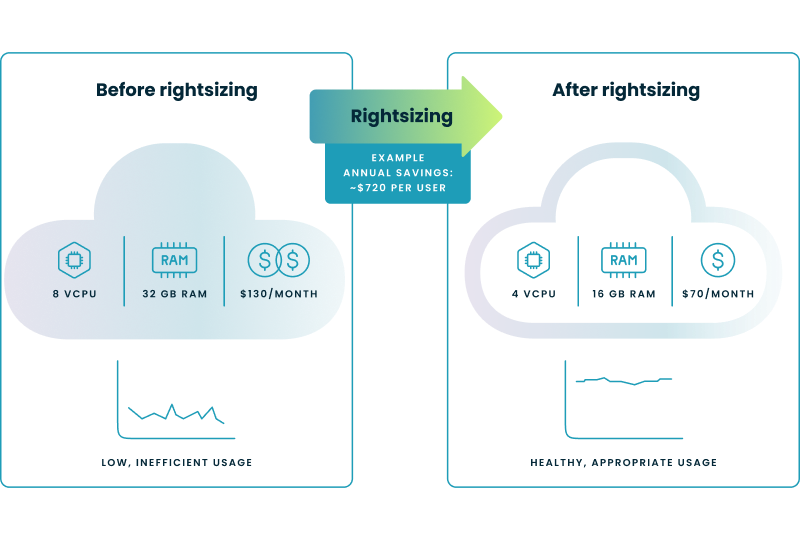
The target is a Cloud PC that keeps the user productive without paying for headroom nobody touches.
The Microsoft Intune admin center has three reports for this, and they are worth checking monthly:
If you run Flex, the Flex connections report shows the most simultaneous connections you have hit per license size, which tells you whether you bought more pooled licenses than you need.
Resizing runs from the Microsoft Intune admin center in four steps.
Downsizing has limits worth knowing before you plan a campaign.
Enterprise Agreement customers have one extra option. Step-up licenses move users to a larger configuration without paying for two full subscriptions. They only work in that direction, and stepping up your whole license count gives you a 90-day window to move users before old access ends.
Yes, when their shifts do not overlap. One pooled Windows 365 Flex license covers up to three users who never need a Cloud PC at the same time, so three Enterprise seats become one Flex seat. Flex is the product Microsoft used to call Windows 365 Frontline, and its Flex overview describes the same capabilities under the new name.
Microsoft pools the licenses across your whole tenant rather than tying them to individuals. Flex Cloud PCs also support automatic power-off at sign-out, which returns the license to the pool for the next person.
Dedicated mode gives each person their own Cloud PC and takes turns activating them. Shared mode gives everyone one Cloud PC and wipes it between users.
Choose Dedicated when people need their own desktop at different hours. Choose Shared when people need any desktop for a short task.
Count the most users who are ever signed in at the same time, then compare that number with how many Enterprise seats you are paying for. The gap is what Flex can recover. Where three users work shifts that never overlap, one Flex license does the work of three Enterprise licenses, and the current price difference between the two editions tells you the saving.
Doing that count by hand across a large workforce is the hard part. Among the Windows 365 management tools built for it, Advisor in Nerdio Manager for Enterprise finds users whose sessions never overlap and flags them as Flex candidates.
Take the license off the user, then end the grace period so the seat is free immediately. Whether a free seat lowers your invoice or just avoids your next purchase depends on your purchasing agreement, which the last part of this section covers.
Removing a user's license does not delete their Cloud PC right away. The Cloud PC moves to an "In grace period" status and the user keeps access for seven days before being signed out.
If you want the seat back sooner, the Deprovision now action ends the grace period on the spot. It permanently deletes the Cloud PC, its operating system, and everything the user stored on it, so treat it as a one-way door.
Build both steps into your offboarding runbook. A departure that only removes the Microsoft 365 license leaves a Cloud PC running for a week and a seat you cannot reuse.
Tie it to your identity system. Disabling a user's Microsoft Entra ID account should trigger a workflow that removes their Windows 365 license and returns the seat to your pool, with no ticket required.
Chasing departures by hand does not hold up across a few thousand people. Back the automation with a monthly look at the usage report's None band, which catches the accounts that slipped past the process.
License parking frees a user's seat without deleting their Cloud PC. Nerdio Manager detaches the assigned Windows 365 subscription license and keeps the user's disk intact, so someone else can use the seat while the original user is on extended leave, and the desktop is waiting when they come back.
It sits between the two blunt options. Leaving the license assigned pays for a desktop nobody is using. Deleting the Cloud PC destroys the user's data and forces a full rebuild on their return.
Parking lets you reuse a seat instead of buying one. It only reduces what you are billed when your agreement lets you cut your license count, and on an agreement that allows a three-month reduction, parking one $158 developer seat through a leave avoids roughly $474.
It changes how fast you can stop paying more than it changes list price. Microsoft sells Windows 365 Enterprise through Enterprise Agreement, Cloud Solution Provider (CSP), Microsoft Customer Agreement, and Web Direct.
Annual CSP terms are the ones to watch. They lock your license count for 12 months with no option to reduce it mid-term, which Microsoft calls a true-down. Buy 200 seats in January for a team that reaches 160, and you pay for 200 through December. Buy conservatively and add licenses as people arrive.Enterprise Agreement is also the one channel that lets you move users up a configuration through the step-up licenses covered earlier, so it gives you more room to adjust seat sizes without buying duplicate subscriptions.
In two places, because Windows 365 bills in two ways. Microsoft Cost Management in the Azure portal shows what you spent on licenses and on any Azure services your Cloud PCs consume. The Microsoft 365 admin center shows how many of those licenses people are using.
Microsoft Cost Management and the Microsoft 365 admin center, and they answer different questions. Windows 365 Enterprise is sold as seats rather than metered Azure usage, which Microsoft calls New Commerce licensing, so license spend and Azure spend arrive through separate paths.
Between them you get what you bought and what people used. The metrics below turn that into decisions.
Five numbers, and each maps to a specific action:
Native tools hand you these numbers separately and leave you to connect them. Nerdio Manager pulls them into dashboards that also track what your cost policies have saved, in a format you can send to the finance team without rebuilding it.
Windows 365 charges a flat price per seat. Azure Virtual Desktop charges for the Azure infrastructure you consume, so its bill rises and falls with actual usage. Once your seats are right-sized and your license pool is clean, the remaining question is whether a given workload belongs on a per-seat price at all. These different pricing models suit different usage patterns, and many enterprises run both for that reason.
Windows 365 bills a fixed amount per user per month. Azure Virtual Desktop bills for the virtual machines, storage, and networking your desktops run on.
The access rights work differently too. Azure Virtual Desktop access comes bundled with Microsoft 365 and Windows Enterprise licenses you likely already own, so there is no per-user Cloud PC license to assign or reclaim. You pay for the virtual machines hosting the desktops instead.
That opens two levers Windows 365 does not have:
Azure reserved instances can discount compute by up to 72%, though Microsoft measures that against pay-as-you-go rates. If auto-scaling is already deallocating capacity overnight, there is less left for a reservation to save, and reservations suit steady workloads better than variable ones.
A complete comparison covers three layers: compute, Microsoft OS and access licensing, and any third-party management platform. The table below covers the first two. Nerdio Manager is priced separately from either model, and neither model requires on-premises hardware.
|
Dimension |
Windows 365 |
Azure Virtual Desktop |
|
How it bills |
Fixed price per user per month |
Azure infrastructure you consume |
|
Compute |
Included in the Cloud PC license |
Charged per VM, plus storage and networking |
|
Microsoft licensing |
Cloud PC license plus the prerequisite licenses for Enterprise |
Access bundled with Microsoft 365 or Windows Enterprise licenses you already hold |
|
Where waste hides |
Seats that are unused, oversized, or wrong for the user |
Idle VMs, and personal desktops where multi-session would do |
|
Predictability |
Same bill next month for the same seat |
Moves with hours, session density, and scaling policy |
|
Cost when nobody is working |
Unchanged, which is what keeps the budget line flat |
Falls, once hosts are shut down and deallocated |
|
Main discount levers |
Flex pooling, right-sizing, step-up licenses |
Auto-scaling at no extra charge, reserved instances up to 72% |
Two billing shapes mean two different jobs when you go looking for savings.
Steady, full-day users on a predictable schedule fit Windows 365, because a flat seat price is cheap when the seat is busy. Variable, seasonal, or shift-based usage fits Azure Virtual Desktop, because scaling down lowers the bill.
The waste you hunt changes with the model. On Windows 365 it is seats: unused, oversized, or assigned to the wrong person. On Azure Virtual Desktop it is resources, meaning VMs left running and personal desktops handed out where multi-session would have served.
The decision also sets how much your team has to run. Azure Virtual Desktop is configured across the Azure portal, PowerShell, and Microsoft Entra ID. Windows 365 removes that work but still leaves you Intune management, application packaging and updates, and license cost control. Our cost comparison guide walks the whole decision, including thin-client scenarios built around Windows 365 Link.
It turns each of the checks above into a policy that runs on its own. Everything in this guide is manageable across ten Cloud PCs. Across a thousand, the monthly review becomes a standing tax on your team's time.
Nerdio Manager is a management and automation platform that runs Windows 365, Microsoft Intune, and Azure Virtual Desktop from one console. Alongside cost control it handles application management, policy backup, reporting, and daily administration across Windows Cloud (Microsoft's umbrella term for Windows 365 and Azure Virtual Desktop).
Right-size the seats, reclaim the ones nobody is using, move shift workers to pooled licenses, and watch what leaves your network. See how Nerdio Manager runs those checks for you: get a demo or try it free in your own Azure tenant.
The configuration you assign each user is the biggest factor, since price scales with CPU, memory, and storage. Edition matters next, because Business, Enterprise, Flex, and Reserve are priced for different kinds of users. Windows 365 Enterprise also requires each user to hold Windows Enterprise, Microsoft Intune, and Microsoft Entra ID P1, so those belong in your per-seat figure. Deployments that route through your own Azure virtual network also pay Azure charges on outbound data, while Microsoft-hosted networking includes a monthly allowance.
Business needs no other Microsoft licenses, stops at 300 seats, and had its list prices cut about 20% on May 1, 2026. Enterprise requires Windows Enterprise, Intune, and Entra ID P1, or a Microsoft 365 suite that includes them, and it is the edition that scales with full Intune management. Flex shares one pooled license across users who work at different times. Dedicated mode covers up to three users with their own Cloud PCs, and Shared mode gives any number of users one Cloud PC, one at a time.
Only for customers who already have it. The benefit discounted qualifying Windows 365 Business subscriptions by up to 16% and never applied to Enterprise. Microsoft retired it from sale on May 1, 2026, though existing subscribers can keep renewing. New Business purchases use the lower standard prices that took effect the same day. Azure Hybrid Benefit is a different program covering Windows Server licensing, and it does not apply to Windows 365.
Right-size each user to the smallest configuration that runs their work, then reclaim the seats nobody is using. Microsoft's Cloud PC usage report flags any Cloud PC with fewer than 40 hours of active connected time over 28 days. For shift workers, compare your peak simultaneous users against your seat count and move the gap to Flex. Use Reserve instead of a full license for people who need a Cloud PC a few days a year, and watch outbound data charges if you route through your own Azure network. Reclaiming a seat lets you reuse it, and whether it lowers this month's invoice depends on your purchasing agreement.
It converts manual cost reviews into policies. It recommends resizes from each user's measured performance history, parks licenses for inactive users while keeping their data, and flags users whose sessions never overlap as candidates for pooled Flex licenses. It also reports what those policies saved, in dashboards built for both IT and finance.
Learn more about Nerdio Manager